
Types of Packaging Foam Material
When choosing packaging foam, it’s important to select the right material for your product’s protection needs. Different foams vary in softness, density, resilience, and cost. Below is a breakdown of the most common types of packaging foam, listed from softest to hardest.
1. Sponge – PU Foam (Polyurethane Foam)
Description:
Polyurethane foam, often called “sponge foam,” is soft, flexible, and highly compressible. It provides gentle cushioning, making it ideal for lightweight and delicate items.
Key Features:
- Very soft and flexible
- Excellent shock absorption for light impacts
- Comes in various densities and colors
- Can degrade over time with exposure to air or sunlight
Common Uses:
- Cushioning for delicate electronics
- Protective inserts in cases and boxes
- Acoustic insulation and padding
Visual:

2. PE Foam (Polyethylene Foam)
Description:
PE foam is broad category polyethylene foam. It is common that when the term PE foam is used, people are referring it to the EPE foam.
PE Foam types:
- EPE foam (non-cross-linked and lower density than XPE/IXPE.)
- XPE/XLPE foam (chemically cross-linked PE foam)
- IXPE foam (irradiated cross-linked PE foam)
It is semi-rigid and lightweight, offering a good balance between softness and strength. It has a closed-cell structure, making it water-resistant and more durable than PU foam.
Key Features:
- Medium hardness
- Water and chemical resistant
- Good impact absorption
- Reusable and non-abrasive
Common Uses:
- Packaging for electronics and appliances
- Protective edge and corner guards
- Floor underlayments and insulation
Visual:

PE foam buyer’s guide with EPE, XPE/XLPE, and IXPE only.
| Type | What it is | Surface / feel | Toughness & recovery | Cost | Best for |
|---|---|---|---|---|---|
| EPE (economical) | Expanded, usually non-cross-linked PE foam | Softer, coarser, more packaging-like | Good cushioning, but less refined and less durable than cross-linked PE foams | Lowest | General protective packaging, simple inserts, edge protection |
| XPE / XLPE (tougher) | Cross-linked PE foam, often chemically cross-linked | Smoother, cleaner, more uniform | Better tear strength, durability, and shape retention than EPE | Mid | Premium packaging, padding, insulation, automotive/interior parts |
| IXPE (finer) | Irradiated cross-linked PE foam | Finest cells, very uniform, premium feel | Strong recovery, thin-but-capable, precise converting | Highest | High-end inserts, electronics, medical, flooring underlay, thin precise parts |
A simple buying rule:
- Choose EPE when price matters most and you mainly need basic cushioning. Sources describing EPE as non-cross-linked and coarser than XPE/IXPE are consistent on this point.
- Choose XPE / XLPE when you want a cleaner finish and better durability. Cross-linking is commonly described as improving mechanical strength, dimensional stability, moisture resistance, and overall finish versus non-cross-linked PE foam.
- Choose IXPE when you want the most refined PE foam with a very fine cell structure and better performance in thinner sections. Multiple sources describe IXPE as irradiated cross-linked PE foam with a finer, more premium structure than standard XPE.
One terminology note: XPE and XLPE are often used interchangeably in supplier catalogs, though some sellers use XPE more specifically for the chemically cross-linked version and IXPE for the irradiated version.
If you’re choosing for packaging only, a practical filter is:
single-use or cost-sensitive → EPE,
nicer insert or repeated handling → XPE/XLPE,
premium thin insert or precision application → IXPE.
2a. EPE Foam (Expanded Polyethylene Foam)
Description:
EPE foam is an expanded version (open-cell structure) of PE foam with improved cushioning and flexibility. It’s softer than rigid foams but maintains strong resilience and shape recovery.
Key Features:
- Lightweight and flexible
- Excellent shock absorption
- Non-toxic and recyclable
- Resistant to moisture and chemicals
Common Uses:
- Protective packaging for glassware, furniture, or auto parts
- Layer padding inside cartons
- Floating and insulation applications
Visual:

2b. XLPE Foam (Cross-Linked Polyethylene Foam)
Description:
XLPE is the board catagory name for cross-linked polyethylene foam. When XLPE is used, it is usually referring to XPE foam.
XPE foam is a chemically cross-linked version of PE foam. It is dense, fine-celled, and has a smooth surface, offering high strength and water resistance.
Key Features:
- Firm and resilient
- Excellent thermal insulation
- Closed-cell and waterproof
- Aesthetic, professional finish
Common Uses:
- Precision instrument packaging
- Medical and automotive components
- Gaskets and seals
Visual:

2c. IXPE Foam (Cross-Linked Polyethylene Foam)
3. EVA Foam (Ethylene Vinyl Acetate Foam)
Description:
EVA foam has a rubber-like texture with higher elasticity and toughness than EPE. It combines flexibility with impact resistance, giving it a premium feel.
Key Features:
- Rubbery, flexible, and durable
- Resistant to cracking and UV light
- Smooth surface, easy to cut and shape
- Available in various colors and densities
Common Uses:
- High-end product packaging (e.g., tools, electronics)
- Sports equipment and protective gear padding
- Shoe insoles and yoga mats
Visual:

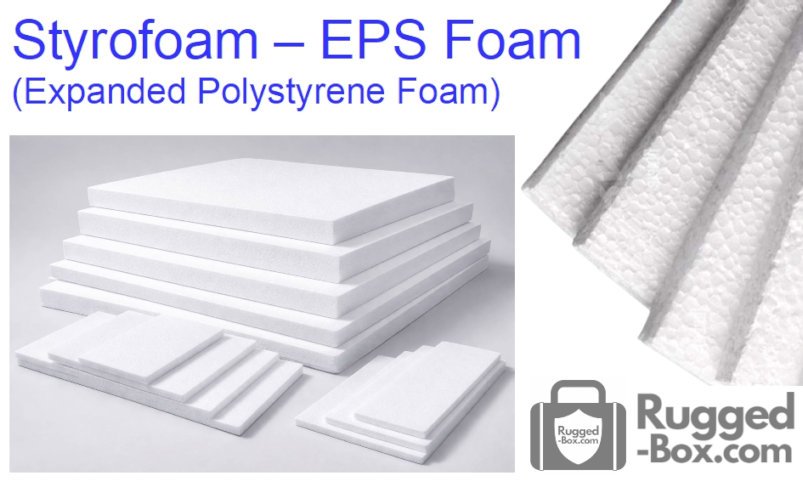
4. Styrofoam – EPS Foam (Expanded Polystyrene Foam)
Description:
EPS foam, commonly known as Styrofoam, is extremely lightweight and rigid. It provides good cushioning for heavy products but is brittle and prone to crumbling.
Key Features:
- Very light and stiff
- Low cost, good thermal insulation
- Brittle and not flexible
- Non-waterproof
Common Uses:
- Product packaging for appliances and electronics
- Disposable coolers and insulation boxes
- Model-making and craft materials
Visual:
Material Grades:
EPS foam is available in varies density and colour. Typically is white in colour.
- 16 kg/m3
- 20 kg/m3
- 24 kg/m3
- 32 kg/m3
Local Styrofoam Suppliers:
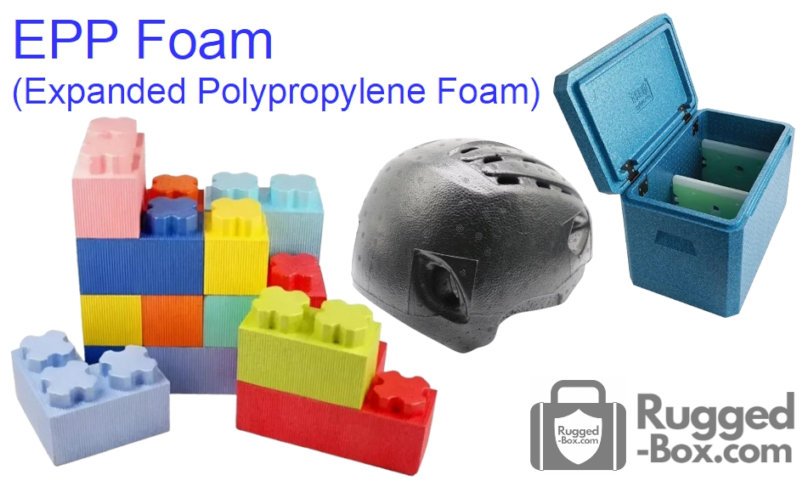
5. EPP Foam (Expanded Polypropylene Foam)
Description:
A denser, harder version of styrofoam. EPP foam is a tougher, more resilient version of EPS. It combines lightness with superior impact resistance and reusability, making it an eco-friendlier option.
Key Features:
- Lightweight yet strong
- Impact-resistant and flexible
- Recyclable and reusable
- Resistant to chemicals and water
Common Uses:
- Automotive components (bumpers, interior padding)
- Reusable packaging and cases
- Drones, RC models, and technical equipment
Visual:

Packaging Foam Comparison Table
| Foam Type | Hardness | Flexibility | Water Resistance | Durability | Common Use |
|---|---|---|---|---|---|
| PU (Sponge) | Very Soft | High | Low | Moderate | Light cushioning |
| PE Foam | Medium | Moderate | High | Good | Electronics, corners |
| EPE Foam | Medium-Soft | High | High | Good | General packaging |
| EVA Foam | Medium-Hard | High | Moderate | Excellent | Premium packaging |
| XLPE Foam | Hard | Low | Excellent | Excellent | Tools, instruments |
| EPS Foam | Hard | Very Low | Low | Poor | Appliances, insulation |
| EPP Foam | Hard | Moderate | High | Excellent | Reusable, automotive |